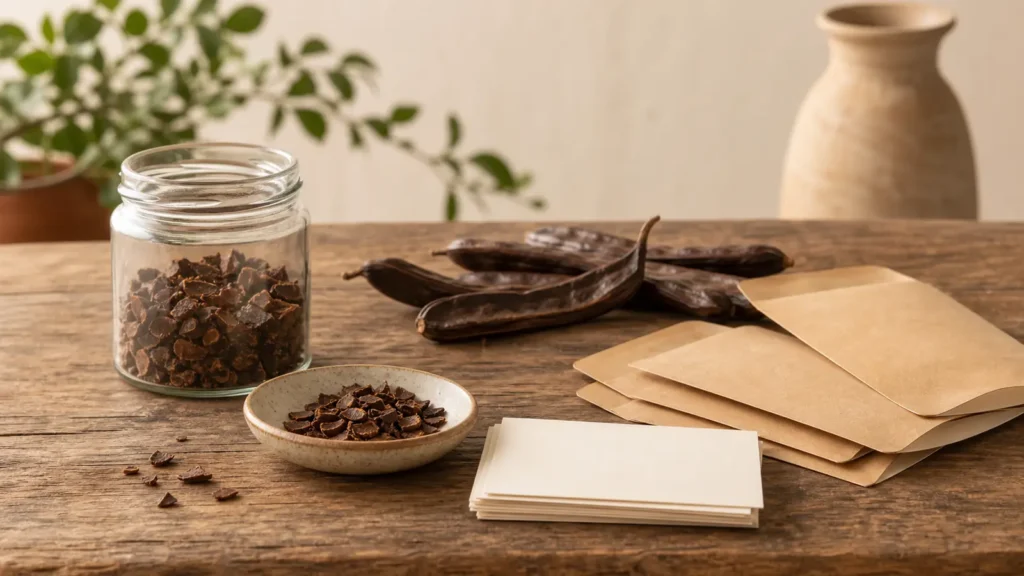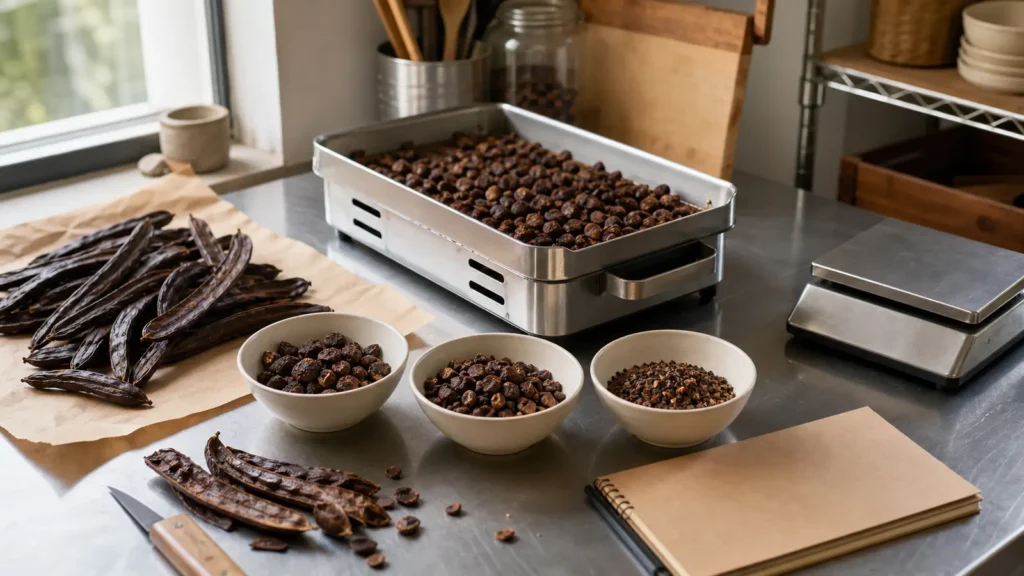

In brief. A whole pod can lead to very different ingredients. Coarse chips are broken pulp pieces suited to trials and infusion. Powder is milled pulp, often roasted. Molasses or syrup is a water extract concentrated into a pourable product. Locust bean gum comes from the seed endosperm through specialised processing. Their flavour, equipment needs, food-safety questions and labels differ, so choosing a format should begin with the intended use.
Chips keep the process visible
Chips or kibbles are pieces of cleaned pod pulp, usually after the seeds are separated according to the chosen process. Their size makes them practical for visual sorting, small roast comparisons and infusion. Customers can see the ingredient, but variation in piece size can produce uneven extraction or roasting.
For a simple first product, chips may require less milling than powder, yet “less processing” does not mean no controls. The pods still need food-grade sourcing, cleaning, sorting, defined moisture management, hygienic packing, traceability and an evidence-based durability.
Powder is convenient but technically demanding
Roasted pulp powder is easy to measure into cakes, biscuits, porridges, smoothies or hot drinks. Particle size influences mouthfeel, mixing and dust. A very fine powder may disperse differently from a coarse flour and can absorb moisture quickly when the pack is repeatedly opened.
A product specification should define roast reference, sieve or particle range, appearance, aroma and acceptance criteria. Milling equipment and the packing environment must be suitable for food. Calling a powder “cocoa” would be inaccurate; it can be positioned as carob with its own taste and recipe behaviour.
Molasses or syrup adds a concentration step
A carob syrup is made by extracting soluble material from the pulp with water and concentrating the liquid. Research using Moroccan pods shows why raw-material composition can influence experimental yield. The finished result may bring sweetness and dark colour to drinks, dairy-style products, sauces or baking.
This route has more process variables: water quality, extraction, filtration, heat concentration, solids, filling hygiene and storage after opening. A glossy bottle is not evidence of stability. Launching a syrup responsibly requires a validated formula and process, suitable packaging and compliant date and storage instructions.
Locust bean gum is a different value chain
FAO describes locust bean gum as material obtained from the endosperm of carob seeds. It is used as a thickener or texturiser in several foods and needs specialised separation and processing. It should not be confused with whole-pod flour, pulp powder or a homemade infusion.
For a small Mamati pilot focused on a low-complexity consumer product, producing gum would be a materially different industrial project. Seeds may instead remain under a documented arrangement with a qualified buyer or processor. Any by-product route needs food-safety, legal and commercial review.
Match the format to a clear job
An infusion blend needs filterable pieces and a repeatable roast. A bakery ingredient needs consistent powder and tested recipe guidance. A topping or drink sweetener needs controlled syrup viscosity and safe filling. Trying to make one product perform every task creates vague instructions and disappointed customers.
Format selection should also consider what Moroccan buyers can understand quickly. A short name, one primary use, a transparent ingredient list and two or three reliable recipes can outperform a complicated range launched before the process is stable.
Compare effort before choosing the first launch
A decision matrix can score each option for equipment, process risk, packaging, shelf-life work, user convenience, margin and access to reliable raw material. Chips may be easier to prototype; powder can be familiar to cooks; syrup may be visually appealing but demands more control. The scores must come from real quotations and trials.
Mamati should resist choosing solely from social-media trends. The strongest first format is the one the team can reproduce, explain, label, store and deliver safely at a price customers accept. Pre-registration can test interest, but it cannot replace technical validation.
Choose by intended use
- Infusion: coarse, filterable pieces with preparation instructions.
- Cooking: consistent powder with tested recipe ratios.
- Pouring or sweetening: validated extracted syrup and filling process.
- Texture modification: specialised locust bean gum, not ordinary pod powder.
Continue through Mamati Notes
From the tree to the pod, Using carob in cooking, and Inside the Mamati Kharroub pilot provide the next practical steps. You can also browse Mamati products or return to Mamati Notes.
Sources, review and limits
This article draws on the sources listed below and was editorially reviewed on 28 July 2026. Names such as syrup and molasses may carry legal or market expectations; final naming must be checked against the actual recipe and Moroccan requirements. It offers general food and product-development information, not medical advice, a certification, a laboratory report for a Mamati lot, or a guarantee of commercial availability.
- FAO — International trade in non-wood forest products — carob gum
- Arabian Journal of Chemistry — Sugar composition and yield of syrup production from the pulp of Moroccan carob pods (2016)
- Codex Alimentarius — General Principles of Food Hygiene (CXC 1-1969) (2022 revision)
- Kingdom of Morocco / ONSSA — Decree No. 2-12-389 on food labelling (2013)