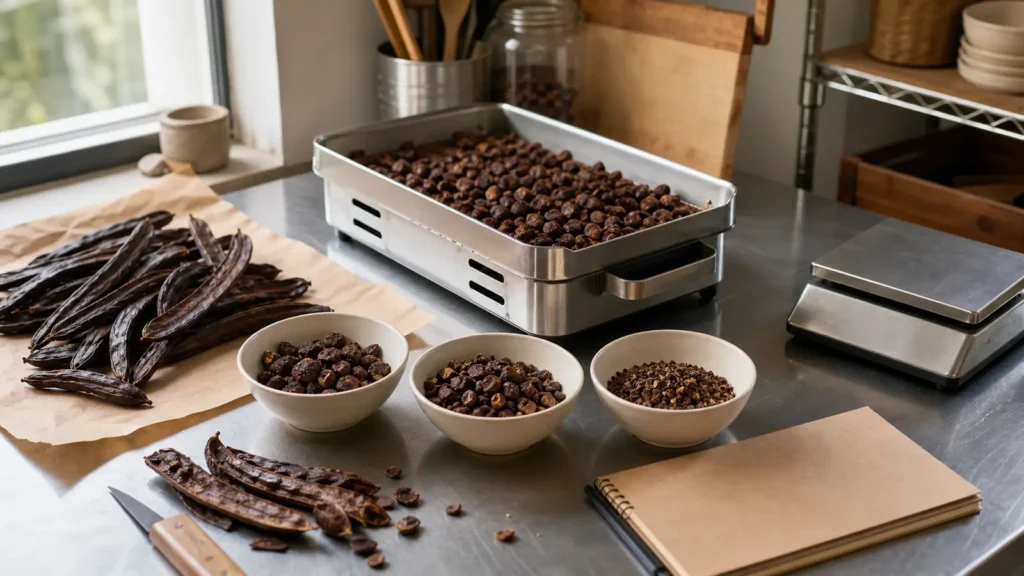

In brief. Pre-registration is a non-binding expression of interest that can help Mamati choose a carob format, pack size, delivery area and first-batch scale. It should not collect payment, imply stock or manufacture artificial scarcity before the product passes sourcing, process, food-safety, packaging and label gates. The result is a planning signal, not a sales forecast, because some interested people will not ultimately buy.
Say exactly what pre-registration means
The form should state that Mamati Kharroub remains in development, that no order is created and that timing, format and price may change. It should distinguish an email update from a reservation. A person must be able to express interest without being told only a few places remain when no verified inventory exists.
Transparency also improves the data. People answer differently when they know a survey is exploratory. Mamati can ask a short preference question and promise to send a clear launch update, rather than hiding market research behind a checkout-style page.
Collect only information that supports a decision
Useful fields may include preferred format, likely pack size, household or professional use, city and chosen contact channel. Name and contact details are enough for updates; dietary or medical questions are unnecessary for selling a general food ingredient. The form should explain how the information will be used.
Consent for product updates should be separate and understandable. Access to the list belongs only to the people who need it, and exports should not circulate through personal devices. A removal request needs a straightforward path. Final data practice must follow applicable Moroccan privacy requirements.
Turn preferences into a cautious batch plan
Count unique, credible responses by format, pack and location, then apply a conservative conversion assumption. Fifty expressions of interest do not equal fifty paid orders. Production should fit qualified raw material, validated equipment, packaging and cash flow, not the largest number a campaign can display.
Geographic concentration matters. A modest group in one deliverable area may be more workable than scattered interest across the country. Professional respondents can be followed up about monthly use, preparation and invoice needs without promising wholesale terms before costs are known.
Prepare the first lot before announcing a date
The input lot, process sheet, pack, label, durability basis and release checks should be approved before a fixed launch date is promoted. Each finished pack needs a traceable batch identity, and the quantity packed must reconcile with accepted input and recorded losses.
A contingency quantity can cover retained samples, checks and genuine packing loss; it should not conceal unrecorded production. If a gate fails, Mamati pauses and tells the waitlist what category of work remains without exposing supplier-confidential or security-sensitive information.
Invite in order, without pressure tricks
When stock is real, the invitation can go to the waitlist in a stated sequence, with price, net quantity, ingredients, delivery area, payment method and a reasonable response window. Any limit should reflect actual batch quantity. Countdown timers that reset or claims of disappearing stock damage trust.
People who do not respond can remain on general updates only if they consented. A later public release should use the same product facts. The waitlist is a communication tool, not a reason to create different ingredient or safety information for different customers.
Learn from the batch, not only the sell-through
Track preparation questions, packaging issues, delivery performance, returns, complaints and repeat intent by batch. Ask a small number of specific questions after enough use: Was the method clear? Did the flavour match the description? Was the pack practical? What recipe was actually made?
Fast sell-through can reflect a tiny batch, not proven product–market fit. A second run should consider repeat demand, operational deviations and margin after real labour and delivery. If a format causes confusion, revising the instructions or pack may be more valuable than scaling immediately.
What the first invitation should include
- Confirmed format, ingredients, pack size, price and available quantity.
- Preparation, storage, durability, lot and operator information.
- Delivery area, timing, payment and contact route.
- A clear distinction between interest, invitation and completed order.
Continue through Mamati Notes
Inside the Mamati Kharroub pilot, Origin and traceability, and Storing carob products provide the next practical steps. You can also browse Mamati products or return to Mamati Notes.
Sources, review and limits
This article draws on the sources listed below and was editorially reviewed on 28 July 2026. Pre-registration cannot guarantee demand, and this article does not announce that a Mamati carob batch is available for sale. It offers general food and product-development information, not medical advice, a certification, a laboratory report for a Mamati lot, or a guarantee of commercial availability.
- FAO — Morocco — Carob as a Special Agricultural Product
- Codex Alimentarius — General Principles of Food Hygiene (CXC 1-1969) (2022 revision)
- ONSSA — Glossary — traceability
- Kingdom of Morocco / ONSSA — Decree No. 2-12-389 on food labelling (2013)
- ONSSA — Official control of plant and plant-origin food products