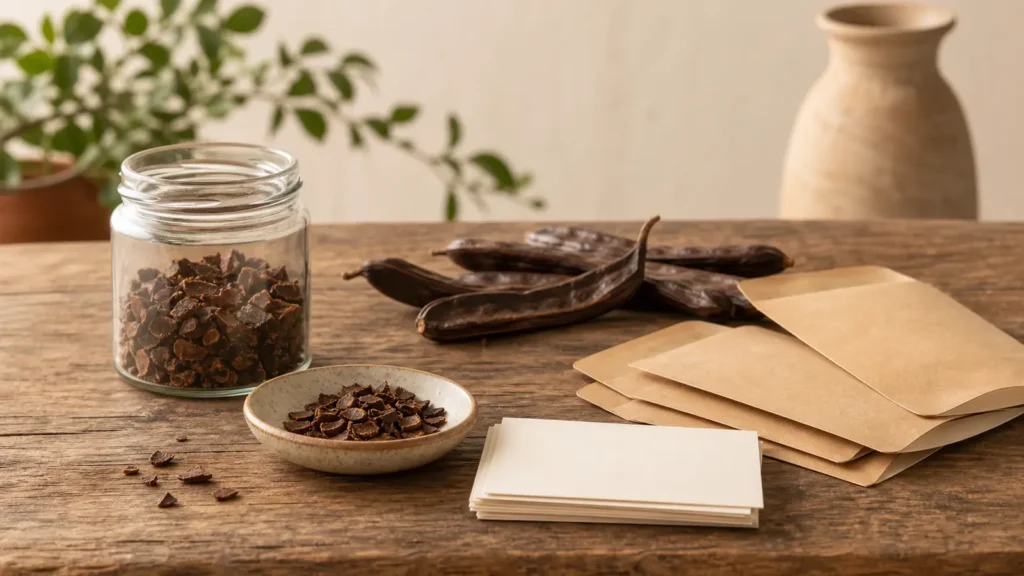

In brief. Mamati Kharroub is described here as a pilot, not a finished certified product. A disciplined pilot moves through gates: choose a clear customer use, qualify food-grade Moroccan pods, define a simple format, run coded process trials, review hazards, select packaging, test durability and labelling, then gather feedback without selling beyond capacity. Publishing the method makes progress understandable while keeping unverified claims out of the brand.
Gate one: a specific problem and customer
“Launch something with carob” is too broad. A useful brief names the customer, occasion and job: for example, a filterable roasted infusion for households, or a culinary powder for cafés and bakeries. It also defines target pack, acceptable preparation time, flavour direction and price hypothesis.
The brief should say what the product will not be. It will not be advertised as a medicine, an exact copy of cocoa or a certified origin unless those points are evidenced. Narrow boundaries reduce unnecessary equipment and make customer testing more meaningful.
Gate two: raw material and traceability
Potential suppliers provide material intended for human food plus information on origin, harvest or collection, handling and batch. Mamati assigns receiving codes, compares lots and records acceptance or rejection. Regional reputation cannot replace evaluation of the delivered pods.
A small pilot should resist blending away differences too soon. Separate samples reveal how origin, maturity and storage affect cleaning, roast and flavour. Once a specification is chosen, traceability connects every trial and retained sample to its input.
Gate three: choose the least complex viable format
Coarse roasted chips may be relatively straightforward to prototype for infusion. Powder adds milling, particle control and dust management. Syrup introduces extraction, concentration, filling and greater stability questions. “Easy to market” and “easy to manufacture safely” are not the same score.
The pilot compares real equipment, packaging, labour, losses and supplier quotations. The first launch should match Mamati’s repeatable capabilities. A future range can expand after the core process and customer demand are understood.
Gate four: coded trials and a target profile
Process trials use uniform samples and record time, temperature, load, cooling, output weight and observations. Coded tasting separates the sample from an attractive name. Evaluation covers intended use, flavour, preparation, residue, consistency and willingness to use again.
A retained reference anchors the chosen profile. The decision is not simply the highest liking score from friends; it combines product fit, repeatability, safety review, cost and feedback from plausible customers such as home cooks, chefs or retailers.
Gate five: safety, packaging and label
Codex hygiene principles support a preventive approach: identify hazards, control suppliers and processes, maintain clean food-contact operations, manage allergens and keep records. The exact plan should be built with qualified food-safety support for the intended Moroccan operation.
Packaging must protect the real format through distribution and use. The label then reflects the final ingredient, net quantity, lot, operator, durability, storage and preparation. No mock-up should display a certification mark, nutrient claim or production statement that has not been authorised and verified.
Gate six: controlled release and learning
A first sale should be limited to quantity the team can make, code, store and support consistently. Complaints, preparation questions and repeat-interest data are logged by batch. A stop rule matters: damaged seals, traceability failure or a process deviation triggers investigation rather than social-media reassurance.
Mamati can share milestones honestly: supplier comparison underway, roast profile selected, packaging under test, or release paused for validation. This language creates trust without pretending that a prototype is inventory. A pilot succeeds when it produces evidence—even if the evidence changes the proposed product.
Launch gates that should all be green
- Defined customer, use, format and product boundaries.
- Qualified inputs, traceable trials and repeatable target process.
- Food-safety review, compliant packaging, label and durability evidence.
- Costed capacity, release quantity, support plan and stop rules.
Continue through Mamati Notes
Origin and traceability, Using carob in cooking, and Preparing the first batch provide the next practical steps. You can also browse Mamati products or return to Mamati Notes.
Sources, review and limits
This article draws on the sources listed below and was editorially reviewed on 28 July 2026. The workflow describes proposed development work and must not be read as evidence that Mamati has completed trials, secured approvals or begun production. It offers general food and product-development information, not medical advice, a certification, a laboratory report for a Mamati lot, or a guarantee of commercial availability.
- FAO — Morocco — Carob as a Special Agricultural Product
- Moroccan Agricultural Development Agency — Guide for young agricultural entrepreneurs in the carob sector (2023)
- Codex Alimentarius — General Principles of Food Hygiene (CXC 1-1969) (2022 revision)
- ONSSA — Official control of plant and plant-origin food products
- Kingdom of Morocco / ONSSA — Decree No. 2-12-389 on food labelling (2013)