
In brief. Carob is the pod of the Mediterranean tree Ceratonia siliqua L.. A mature pod contains sweet pulp around hard seeds, and the two fractions enter different value chains. Between harvest and a food ingredient come drying, sorting, cleaning, lot identification and, depending on the intended format, deseeding, roasting, milling or water extraction. Moroccan origin matters, but origin alone cannot replace a specification for the actual lot.
A Moroccan crop with more than one story
The carob tree is evergreen and belongs to the legume family. Morocco’s Agricultural Development Agency identifies Béni Mellal–Khénifra and Fès–Meknès among the principal producing regions, while FAO has selected carob as Morocco’s product in its One Country One Priority Product initiative. Those facts explain why the crop attracts attention; they do not mean every pod has the same composition, cultivation history or quality.
Trees grow under varied soils, rainfall and farm practices. Calling carob simply “a tree that needs no water” is misleading. Established trees are associated with Mediterranean dryland conditions, yet young trees, orchards and yields still respond to water availability, site management and weather. Responsible brand language should celebrate resilience without erasing agricultural work.
Inside a mature pod
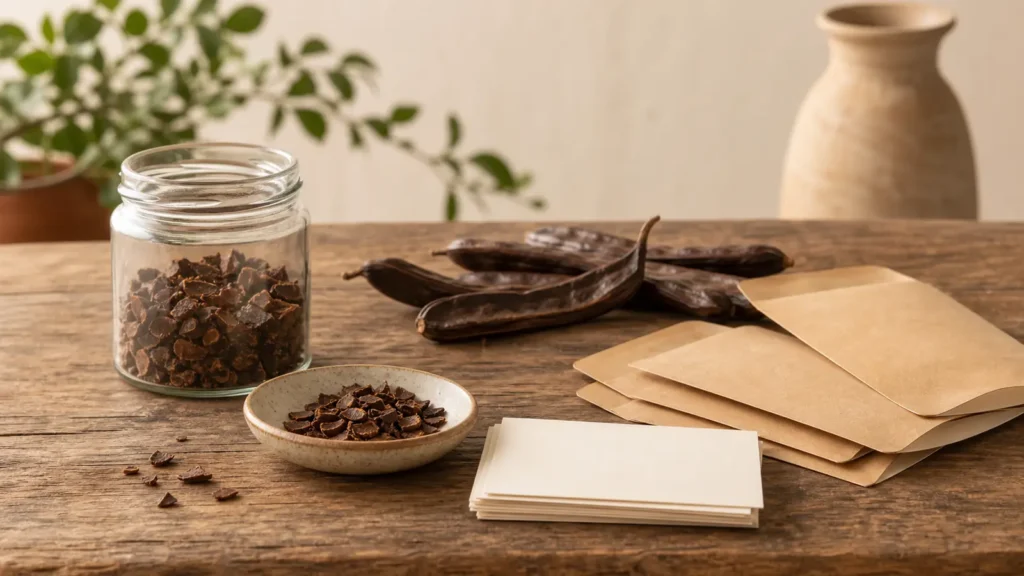
The brown pod has two commercially distinct parts. The pulp is fibrous, naturally sweet and aromatic. It can be broken into pieces, roasted and milled, or extracted with water. The hard seeds contain endosperm used to make locust bean gum after specialised processing. Carob pulp powder and locust bean gum are therefore not two names for the same ingredient.
This distinction also prevents an unhelpful comparison with cocoa. Roasted carob may work in some cocoa-style recipes, but it contains different flavour compounds and behaves differently. A truthful product description starts with what the ingredient is, how it was processed and what the customer can expect from it.
Maturity is more than a brown colour
A brown pod is a useful visual signal, not a complete acceptance test. Moisture, damage, insect activity, mould, foreign material and odour also matter. Harvest timing influences how easily the pod stores and how it tastes after processing. Lots collected in different places or at different stages should not be mixed merely to make a larger batch before they are assessed.
Research on Moroccan material has found measurable diversity in pod and seed characteristics across provenances. Another study of Moroccan pods reported differences relevant to experimental syrup production. These studies demonstrate variability; they do not rank all regions or predict the performance of a commercial Mamati lot.
Sorting and cleaning create the first quality gate
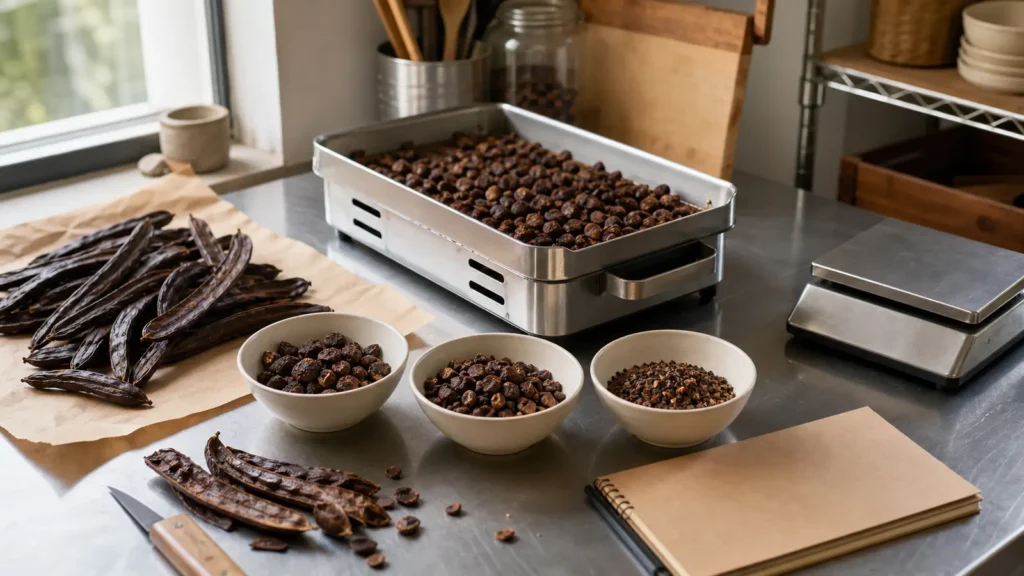
After reception, visibly mouldy, wet, severely damaged or contaminated pods should be separated according to a documented food-safety procedure. Dust and foreign material require suitable cleaning before food processing. A pleasant-looking photograph cannot establish safety, and a sweet smell cannot determine shelf life.
The receiving record can be simple: supplier, stated area of origin, delivery date, lot code, weight and observations. Keeping samples or photographs under that code may help later comparisons, but neither replaces appropriate testing. Traceability begins before roasting, when information can still be connected to the intact batch.
From whole pod to useful formats
Clean, suitably dry pods can be broken into chips for controlled trials. Depending on the product, seeds may be separated before the pulp is roasted or milled. Powder needs a defined particle size, while an infusion blend benefits from pieces large enough to filter. Syrup or molasses requires water extraction and concentration plus validated controls for hygiene and stability.
Each format creates its own questions. How uniform is the roast? Does the powder absorb moisture? Is an extracted product stable after opening? Answering those questions for a real pilot is more useful than attaching broad wellness language to an ingredient that has not yet been characterised.
What Moroccan origin should let a buyer verify
Credible origin is built from linked records: who supplied the pods, the stated collection or production area, the date, quantity, receiving lot and transformation batch. A map icon or a pastoral image is not proof. If a narrower geographic claim cannot be documented, “sourced in Morocco” is clearer than inventing village-level precision.
For Mamati Kharroub, the practical goal is to compare real samples under the same small-batch method, record differences and select specifications that can be repeated. A future label should say only what the records support and should never imply an organic status, protected origin or public certification without the corresponding authorisation.
Questions to ask when buying pods
- Is the lot intended for human food, and how was it cleaned?
- Are origin, reception date and batch identity documented?
- Are moisture, foreign material, insects and abnormal odours controlled?
- Which part of the pod is used, and are the seeds removed?
Continue through Mamati Notes
How roasting changes carob, Carob formats explained, and Origin and traceability provide the next practical steps. You can also browse Mamati products or return to Mamati Notes.
Sources, review and limits
This article draws on the sources listed below and was editorially reviewed on 28 July 2026. National production figures and sector targets can change, and scientific samples do not describe every Moroccan harvest. It offers general food and product-development information, not medical advice, a certification, a laboratory report for a Mamati lot, or a guarantee of commercial availability.
- Moroccan Agricultural Development Agency — Carob sector guide
- FAO — Morocco — Carob as a Special Agricultural Product
- FAO AGRIS / Scientia Horticulturae — Fruit and seed diversity of domesticated carob in Morocco (2009)
- Arabian Journal of Chemistry — Sugar composition and yield of syrup production from the pulp of Moroccan carob pods (2016)